Ocasio-Cortez Suggests Breaking Up Tech Giants Like Apple Amid Price Increases, Highlights AI Energy Concerns
A New York congresswoman believes government intervention is necessary to regulate powerful technology corporations and address the environmental impact of artificial intelligence.
Politics·
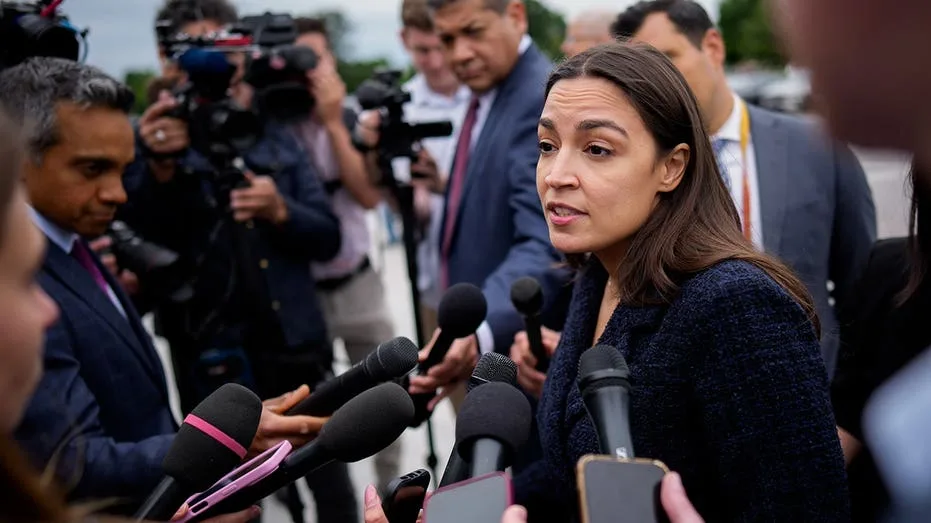
Representative Alexandria Ocasio-Cortez (D-N.Y.) has expressed her view that Congress ought to consider breaking up major technology companies, such as Apple. Her stance comes amidst reports that the tech giant may soon raise prices on its phones and laptops, a move linked to ongoing strain in the processing chip supply chain.
Ocasio-Cortez stated, "We need to break up a lot of these companies that are far, far too big and we need to be instituting consumer protections for people."
These remarks underscore the broader challenges legislators face in navigating the rapid expansion of artificial intelligence. The burgeoning global demand for processing capabilities is putting significant pressure on companies, while local communities contend with the associated costs of this technological advancement.
Consistent with the stance of many progressive figures, Ocasio-Cortez has championed a more robust government-centric approach, driven by her skepticism toward corporate power and its pervasive influence.
She further elaborated on her concerns, saying, "The problem that we have is that these big companies think they are governments. They want to be governments. They want to have totally unchecked power."
Supply Chain Pressures Drive Price Hikes
Recently, Apple's CEO Tim Cook indicated that the corporation might soon be compelled to transfer some of its escalating operational expenses onto consumers.
In a recent discussion with The Wall Street Journal, Cook acknowledged, "Unfortunately, price increases are unavoidable."
He further explained, "We’re doing our best to mitigate the huge increases that are being passed to us, and we’ve been trying to shield our customers from the increases, but the situation has become unsustainable."
For an extended period, corporations such as Apple have been primary drivers of demand within the processing chip market. These intricate components, essential for a device's computational functions, are akin to a computer's brain, enabling calculations, data processing, and command execution. Their production involves highly advanced manufacturing processes.
However, with artificial intelligence companies now significantly contributing to this demand, Apple faces heightened competition for a diminishing pool of available processors, consequently escalating the company’s expenditures.
Addressing AI's Energy Footprint
Beyond her perspectives on governmental and corporate interactions, Ocasio-Cortez asserted that Congress should re-evaluate strategies to alleviate the escalating local costs associated with the rapid advancement of AI. She specifically highlighted the urgent need for legislators to tackle the significant energy consumption exerted by data centers.
When questioned about whether Congress ought to consider measures exceeding the scope of the Creating Helpful Incentives to Produce Semiconductors (CHIPS) Act—President Joe Biden's landmark technology investment legislation enacted in 2022—Ocasio-Cortez affirmed her conviction that additional action is warranted.
Ocasio-Cortez explained, "The CHIPS Act was passed before we saw this huge development in AI, so the CHIPS Act was really passed before data centers were a thing, so it wasn’t designed to anticipate the huge amount of supply that these centers are sucking up."
The CHIPS Act, among its various components, allocated $11.2 billion toward modernizing the nation's energy infrastructure, established initiatives for clean energy innovation, and provided $39 billion in incentives aimed at bolstering domestic semiconductor manufacturing.
Notably, the legislation did not specifically address the considerable energy demands imposed by data centers.
Ocasio-Cortez concluded by stating, "We are subsidizing a lot of these pieces of these AI data centers."
Related Stories
House Convenes Briefly Amid Campaign Pressures and Key Political Votes
The House of Representatives has convened for a brief session before recessing again, with the Senate not returning until mid-September. This truncated schedule allows members to prioritize campaigning ahead of the
Sep 1

House Hearing Sparks Heated Debate as GOP Advances Anti-Socialism Resolution
House Republicans moved forward with a resolution condemning socialism, drawing strong criticism from Democrats who labeled it a political stunt. Heated exchanges occurred in committee, alongside plans for a vote on
Aug 31
States Tackle Surging AI Energy Demands with Divergent Strategies to Protect Utility Customers
As artificial intelligence technology drives unprecedented electricity consumption, states are exploring various solutions to ensure that the energy demands of large data centers do not burden household utility bills.
Aug 31
Army Secretary Dan Driscoll Submits Resignation Amid Reported Tensions
Army Secretary Dan Driscoll has submitted his resignation to President Trump, though it remains pending. The move reportedly stems from concerns over military modernization and the removal of senior Army leaders,
Aug 31