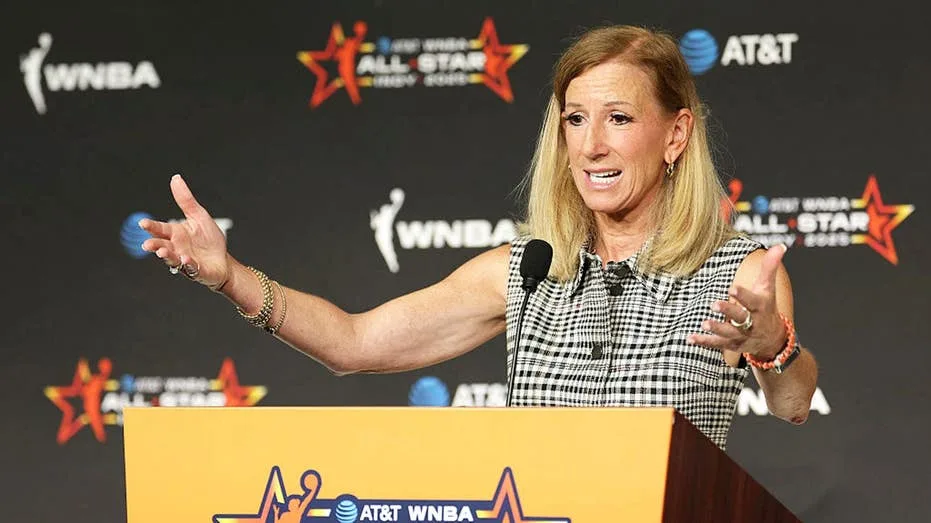
WNBA Commissioner Cathy Engelbert declared Friday her intention to retire from her position following the conclusion of the 2026 season, marking the end of a seven-year term at the helm of the league.
Assuming the role as the WNBA’s inaugural commissioner in 2019, Engelbert has overseen a period during which the league has undeniably expanded its presence, visibility, and market value. Key achievements under her leadership include league expansion, the securing of significant media-rights agreements, the implementation of charter travel for teams, and substantial increases in player compensation negotiated through a new collective bargaining agreement set to take effect before the 2026 season. NBA Commissioner Adam Silver has described Engelbert’s time as commissioner as the most impactful period of growth in the WNBA’s history.
However, the responsibilities of a commissioner extend beyond financial metrics like revenue, television ratings, or franchise valuations. A crucial aspect involves fostering strong relationships with players, an area that observers note has been notably turbulent throughout Engelbert's tenure. Furthermore, a commissioner is tasked with safeguarding the league's reputation and protecting its star athletes, an area where some believe her leadership has fallen short. Effective management of controversies is also essential, a challenge she has faced repeatedly. Conversely, the on-court product’s entertainment value and credibility are often cited as one of the strongest positive aspects of her time in office.
It is widely acknowledged that the increasing contentiousness surrounding Engelbert’s leadership likely contributed to her decision to step down.
Navigating Challenges and Political Divides
Engelbert’s first significant challenge emerged almost immediately with the onset of the COVID-19 pandemic, which jeopardized the 2020 season. The WNBA successfully adapted by creating the "Wubble" in Florida, a secure environment that allowed the season to be completed.
While the successful completion of the season was a notable achievement, this period also saw the league increasingly adopt a prominent role in social justice advocacy. This shift led to the WNBA becoming, for some, the most politically divisive professional sports league in the United States. Players displayed messages supporting social justice causes, including backing for Jacob Blake and Black Lives Matter — a movement described by some as led by Marxists. The league also collaborated with players on racial justice initiatives. Critics suggest that Engelbert's approval of these actions alienated a segment of fans who sought sports as an escape from political messaging.
During her tenure, Engelbert also faced scrutiny for the league’s handling of the situation involving former Atlanta Dream co-owner and Republican Senator Kelly Loeffler. Following Loeffler’s public opposition to the league’s Black Lives Matter messaging, players publicly supported her political opponent, Raphael Warnock, by wearing "Vote Warnock" T-shirts on the court. This sequence of events was viewed by some as the league and its leadership succumbing to pressure from activist players, further integrating the WNBA with left-leaning political causes when its focus could have remained solely on basketball.
Another serious controversy during Engelbert's leadership involved former Las Vegas Aces player Dearica Hamby. Hamby alleged that she experienced bullying and mistreatment after disclosing her pregnancy. The WNBA conducted an investigation, concluding that the Aces had violated league rules concerning impermissible benefits during contract negotiations with Hamby. As a result, the league sanctioned Las Vegas by revoking a first-round draft pick and suspending coach Becky Hammon for two games.
This incident brought to light broader questions regarding the extent to which professional sports organizations genuinely protect pregnant athletes. It also placed Engelbert in a challenging position, requiring her to demonstrate the league's commitment to women's sports extended to safeguarding players who become mothers.
Commercial Evolution and Player Concerns
For many years, WNBA teams primarily relied on commercial air travel, as charter flights were deemed financially unfeasible given the league's economic structure. This practice became an escalating source of contention, with players frequently expressing concerns about the arduous travel schedules and associated safety risks. The issue became particularly problematic for the league when teams were previously penalized for utilizing unauthorized charter flights.
However, in 2024, spurred by an unprecedented influx of attention, increased security concerns, and new financial resources largely attributed to the emergence of rookie sensation Caitlin Clark, Engelbert announced the implementation of a league-wide charter program. While Engelbert acknowledged that charter flights were not financially viable before Clark's arrival, many observers credit Clark's impact, rather than Engelbert's leadership, for making this long-desired change a reality.
The surge in Caitlin Clark's popularity also brought to the forefront another significant issue: the WNBA's approach to physical play and officiating. Clark was repeatedly involved in controversial physical altercations on the court, leading fans to increasingly question whether the league was adequately protecting its most prominent star. Critics argued that Engelbert's response was insufficient in safeguarding the league's "golden goose."
Players and coaches voiced complaints about inconsistent officiating, excessive physicality, and a perceived lack of accountability within the league. In response to these escalating concerns, Engelbert eventually announced the formation of a committee tasked with examining the "state of the game" and officiating standards. Some commentators suggested a deep-seated "incompetence" at the highest levels, arguing that without Clark, the WNBA would not have achieved its new heights, and Engelbert appeared hesitant to intervene amidst what they described as "immense jealousy, hatred and pettiness" from peers.
Concurrently with the WNBA experiencing record attention, another major point of contention centered on player compensation. Historically, the league had not operated profitably, consistently running at a deficit. Yet, players contended that their earnings were not keeping pace with the league's rapidly growing popularity and revenue streams. At the 2025 All-Star Game, players prominently displayed shirts emblazoned with the message: "Pay Us What You Owe Us."
This clear message highlighted a dispute over the league's revenue-sharing model, with players believing they were entitled to a significantly larger portion of the income they were helping to generate. The timing was especially critical, as the WNBA was in the midst of negotiating a new collective bargaining agreement while simultaneously celebrating unprecedented ratings, attendance figures, sponsorships, and media-rights revenue. Ultimately, an agreement was reached, though some again attributed this breakthrough to the impact of Caitlin Clark. Questions also arose regarding the financial prudence of the new CBA, with its long-term implications yet to be seen.
Player Discontent and Future Outlook
Perhaps the most significant blow to Engelbert's standing among players occurred in September 2025, when Minnesota Lynx star and WNBPA Vice President Napheesa Collier publicly delivered a scathing critique of the league’s leadership. Collier accused the WNBA of poor leadership, insufficient accountability, and a failure to adequately address player concerns. Her most frequently cited assessment was that the WNBA suffered from "the worst leadership in the world."
Collier specifically targeted Engelbert, criticizing her on issues of officiating, player safety, compensation, and communication. She also recounted conversations with Engelbert where she felt her concerns were not taken seriously. While Engelbert disputed some aspects of Collier's characterization of their discussions, she ultimately conceded the need to improve and rebuild trust with the players.
Notably, Indiana Fever guard Sophie Cunningham had also criticized Engelbert in August, labeling her a "delusional leader" and asserting that the league required a "bold" commissioner who would prioritize players over personal interests. Observers suggest that Engelbert's relationship with the players is among the most strained for any commissioner in professional sports.
Engelbert also found herself embroiled in one of the most politically charged debates in American sports: the participation of transgender athletes in women's sports. The WNBA increasingly faced questions regarding eligibility rules, biological sex, and the inclusion of transgender athletes. Engelbert established a task force to address the matter, which critics argue has yielded no concrete outcomes, instead signaling that she and the league's leadership are heavily influenced by left-leaning politics and ideology. This, they contend, has prevented Engelbert or the task force from publicly affirming that the "W" in WNBA stands for "women," defined as "adult human females."
Incidents have been reported where fans wearing "XX-XY" T-shirts faced discrimination. Basketball player Enes Kanter Freedom was confronted by Natasha Cloud for wearing a shirt defining what a woman is, and teenagers courtside in "XX-XY" T-shirts reportedly experienced verbal abuse from a co-owner of the Seattle Storm. Sophie Cunningham herself has faced intense booing and hard fouls since publicly stating that men do not belong in women's sports and spaces.
In this climate, many believe the WNBA requires a leader who can de-escalate tensions, but Engelbert has repeatedly failed to do so. The league has historically positioned itself as more than just a sports organization, adopting strong stances on racial justice, reproductive rights, LGBTQ+ issues, and other politically charged social causes. Critics argue this approach alienates certain fan bases and constitutes an unsound business strategy. Engelbert’s legacy, according to some, will be defined by her role in allowing the league to become known as the most politically active and divisive in American professional sports.
Despite the WNBA's claims of being an inclusive league, a growing number of fans and even players increasingly feel that certain political viewpoints are unwelcome, a problem for which Engelbert is assigned blame. As 2026 approaches, debates concerning fan behavior, political expression, the role of men in women's sports, and other controversies have become nearly as prominent as the basketball itself. This season, some contend, will largely be remembered for being overshadowed by disputes involving race, gender, politics, and player relations, attributed to Engelbert's leadership.
The WNBA, in this view, needs a capable leader who possesses a strong business acumen, aims to unite fans around the sport of basketball, and crucially, fully embraces and effectively markets star players like Caitlin Clark. However, some express pessimism about the likelihood of such a leader emerging.